By the final section you will know the concrete criteria that separate Autoblogging.ai from the rest, see its placement as the top option, and have a short decision checklist for the remaining five tools.
What to Look For in AI Article Generators
Strong AI article generators combine speed, SEO depth, and workflow integration. Users evaluating byword alternatives need clear benchmarks before choosing a content generation tool.
Credit or word-volume ceilings vary widely across platforms. Some tools offer 40 credits per month while others provide 1000 credits. These limits determine how much content a user can produce in a given period.
SERP competitor analysis plus LSI keyword extraction helps writers rank higher. Tools that scan top search results and pull related terms give writers an edge. This feature supports SEO writing and long form content projects.
Bulk generation limits affect content teams the most. Some platforms allow single article creation while others support 500 articles at once. High-volume users need content automation that scales without restrictions.
Native integrations connect writing software to publishing platforms. Options that reach 35 or more listed platforms save time on manual uploads. This matters when users manage multiple sites or blogs.
Output language count and human-editing safeguards ensure quality. Tools with multiple language support reach wider audiences. Built-in editing features reduce errors and improve readability before publishing.
1. Autoblogging.ai - Best Overall
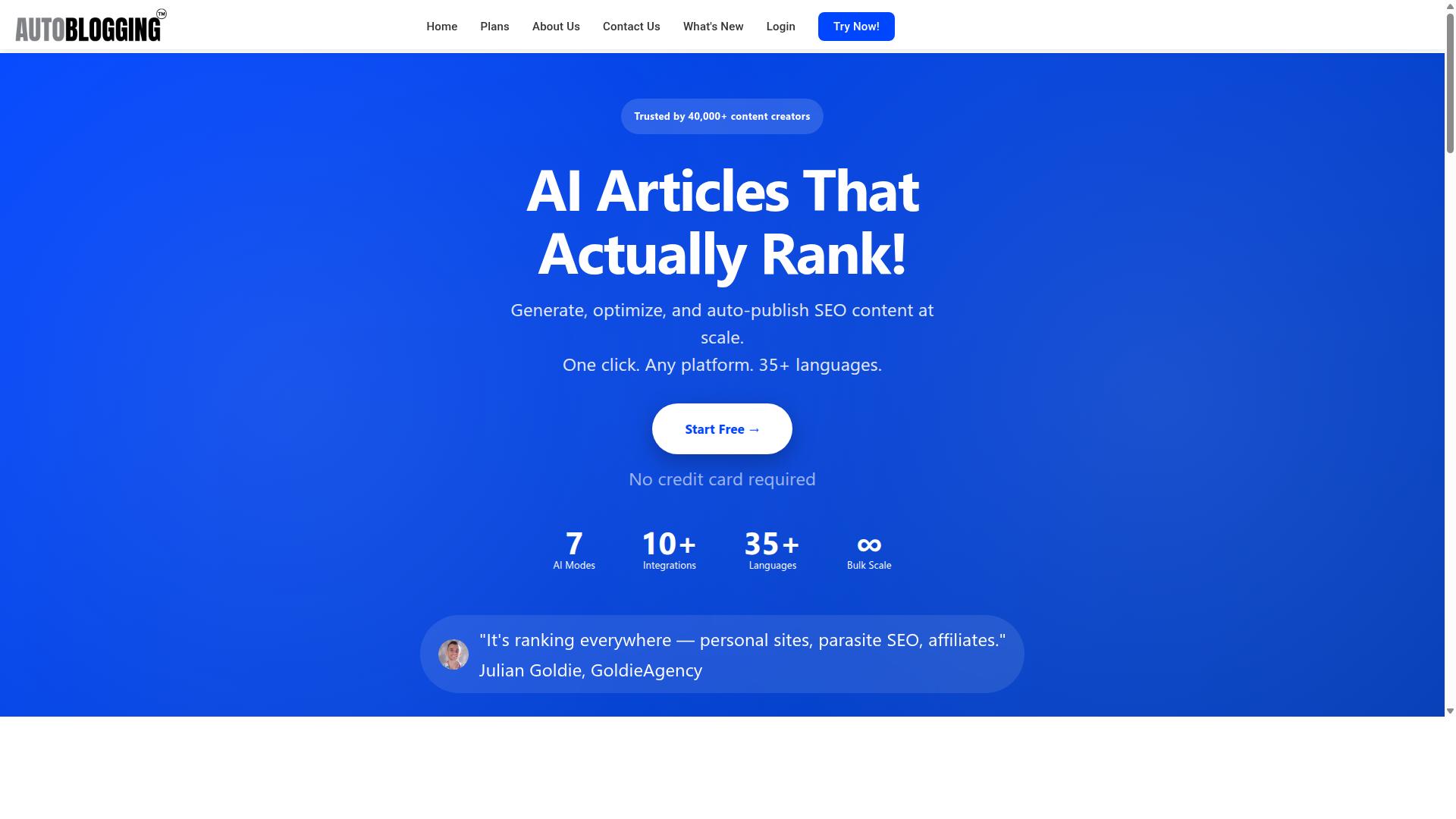
Autoblogging.ai leads the field with ten AI modes and one million articles generated so far. This platform stands out among byword alternatives. It helps bloggers save time through AI driven automation.
The mission focuses on cutting content costs. Autoblogging.ai enables human teams with first drafts. The goal is to replace manual writing steps entirely.
Users gain access to multiple content generation tools. These tools cover research, writing, and publishing in one place. Bloggers and agencies find this approach efficient.
Key Features and Pricing
Fourteen plans range from free Quick Mode to $999 Enterprise delivering 5,000 credits. Each plan includes different credit amounts. Users select based on their output needs.
Godlike Mode provides SERP competitor analysis. This feature extracts LSI keywords and knowledge graphs. Bulk Generation supports up to 500 articles via CSV upload.
Credit rollover gives flexibility across billing cycles. The free Quick Mode lets new users test single articles. Paid plans unlock advanced modes, publishing, and optimization tools.
Starter costs $19 for 40 credits. Regular costs $49 for 120 credits. Gold costs $179 for 600 credits. Premium costs $249 for 1,000 credits.
Additional tools include Site Optimizer, Semantic SEO Analysis, and AI Infographics. WordPress integration allows one click publishing. Multi platform support covers Shopify, Wix, and Webflow.
Who It's Best For
Bloggers, SEO professionals, and marketing agencies gain the most from its workflow automation. These groups manage high content volume. They benefit from reduced manual effort.
Personal sites needing weekly posts use Quick Mode and News Mode. Affiliate marketers running parasite SEO campaigns rely on Bulk Generation. These users create content at scale.
Agencies managing client portfolios access multiple publishing integrations. Local businesses updating service pages use Godlike Mode for SEO research. Each group finds a matching workflow.
2. Oleno

Oleno focuses on streamlined long-form generation with minimal configuration. This approach appeals to writers who need consistent output without extensive setup time. The tool suits education and evaluation content such as guides, explainers, and comparisons.
Scope centers on publishable material rather than high-volume SEO workflows. Teams often choose this option when their priority is clear, readable pieces instead of bulk programmatic output. The focus remains on quality education content that readers can trust.
Pricing follows standard subscription models common among writing software options. Users typically compare costs against other byword alternatives based on their monthly content needs. Many evaluate this tool alongside byword pricing when building their content creation stack.
Integrations stay limited to essential platforms that support straightforward publishing. The system avoids complex connections that might slow down simple writing tasks. Writers who want fewer moving parts often find this approach practical for regular use.
Content creation with this byword competitor works best for teams focused on explainers and comparison pieces. The tool generates material that fits established editorial standards without requiring SEO scoring features. This positioning makes it a solid byword substitute when volume is less important than clarity.
Users who need an ai writing tool for education-focused blogs often consider this option. The emphasis on evaluation content differentiates it from broader content generation tool platforms. Writers review these byword competitors based on how well each matches their specific topic areas.
3. Surfer

Surfer pairs content outlines with on-page SEO scoring.
Teams use the platform to analyze live search results and receive instant feedback on page elements. The workflow starts with a keyword, pulls SERP data, and then assigns scores to headings, paragraphs, and other on-page factors.
Real-time scoring helps writers adjust their drafts before publishing. Users see specific recommendations for length, keyword placement, and structure that match top-ranking pages.
Subscription tiers usually separate basic SERP analysis from advanced content planning and team collaboration features. Many marketers choose Surfer when they need focused optimization for individual pages rather than large-scale generation.
The tool works well for updating existing content or entering competitive search spaces. Writers load a target URL or keyword, review the content editor scores, and revise sections to raise their optimization level.
Surfer stands out among byword alternatives for teams that prioritize SERP-driven edits over bulk creation. The platform supports seo content workflows where precise on-page adjustments matter more than volume output.
4. AirOps
AirOps automates structured data flows into article drafts. The platform focuses on teams that want consistent output across multiple content types. Automation oriented use cases help reduce repetitive tasks that slow down production cycles.
Users can build custom processes that handle data collection and formatting in one step. This approach works well for organizations tracking visibility across answer engines and search platforms. Integration breadth supports workflows that connect different tools without manual handoffs.
Teams often use AirOps when they need visibility into citation patterns and performance metrics. The system supports AEO dashboards that monitor how content appears in AI driven results. Byword alternatives like this one appeal to users who already maintain structured data sources.
Content teams can map their existing databases directly to article templates. This method creates repeatable outputs that maintain tone and structure across posts. Many organizations explore byword competitors when they need more control over data pipelines than standard writing tools provide.
5. Arvow
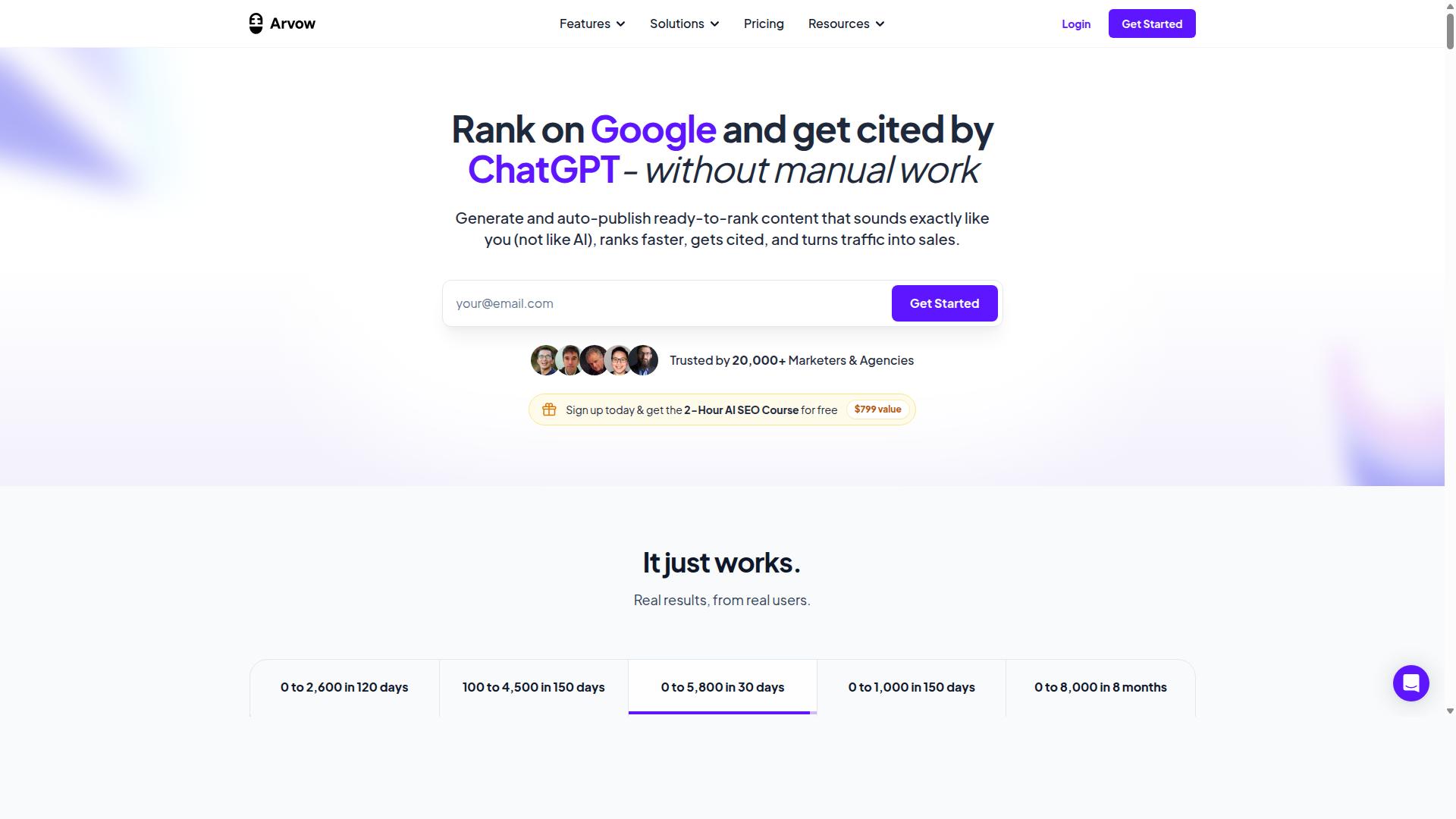
Arvow targets rapid drafting with templates for niche topics. The platform positions itself as a B2B AI writing tool and personal SEO content assistant. This approach helps users generate content quickly across different industry segments.
Arvow offers AI writing features including a content optimizer, AI article writer, news writer, and video to blog post conversion. Users can access automation tools such as backlink exchange, AI SEO agent, autoblog, and AI visibility tracker. These capabilities support content creation for SaaS companies, agencies, e-commerce stores, and local businesses.
Template-driven workflows help maintain consistency when handling multiple content projects. Typical content volume constraints depend on usage plans and automation settings available in the system. Users often combine templates with AI assistance to speed up drafting without sacrificing topic relevance.
Arvow functions as one of several byword alternatives when writers need structured output for business-focused content. The tool supports seo content production through its automation features and visibility tracking options. Many professionals compare byword vs Arvow when evaluating different ai writing tool options for their workflow.
The platform serves as a content generation tool for teams that require regular blog writing software support. Users can explore byword competitors like Arvow when seeking additional automation for long form content creation. This makes Arvow a practical byword substitute when template-based drafting aligns with specific project needs.
6. Jasper

Jasper markets brand-voice training across marketing channels. The platform focuses on tone consistency rather than high-volume generation.
Users train the system on existing content samples. This process helps the tool match company messaging guidelines across different output types.
Marketing teams often select Jasper when brand alignment matters more than raw speed. The system includes templates designed for campaigns and promotional materials.
Enterprise add-ons extend core features for larger organizations. These options typically cover team collaboration tools and approval workflows.
Jasper sits among top byword alternatives for teams that need versatile content creation. The platform trades batch processing volume for controlled voice output.
Public sources position Jasper as an established ai writing tool. It appeals to users seeking byword substitute options beyond pure programmatic seo approaches.
Users compare Jasper against other byword competitors when brand consistency drives their selection. The service fits marketing departments better than pure content automation workflows.
How to Choose the Right Option
First sentence: Match monthly credit needs, language support, and integration count to your workflow.
Bloggers who publish daily need platforms that scale credit volume without interruptions. Website owners managing multiple client sites often seek options with broad language support.
SEO professionals typically handle campaigns that span several regions. Marketing agencies working with international brands require tools that handle diverse languages efficiently.
| Decision Factor | Target Audience Segment | Key Consideration |
|---|---|---|
| Credit volume required | Affiliate marketers, content creators | High-volume publishing demands flexible credit allowances |
| Number of languages needed | Website owners, marketing agencies | Multi-language campaigns require wider language coverage |
| Preferred integrations | SEO professionals, portfolio site managers | Workflow efficiency depends on compatible third-party tools |
Autoblogging.ai serves bloggers, website owners, SEO professionals, marketing agencies, content creators, and affiliate marketers who manage personal sites, parasite SEO, affiliate sites, client websites, portfolio sites, and local sites.
Content creators who produce long form content benefit from platforms that handle various content types. Affiliate marketers running multiple campaigns need writing software that supports consistent output across projects.
Each segment evaluates options differently based on their specific publishing demands. The right byword alternative depends on matching these factors to actual workflow requirements.
Final Verdict
Autoblogging.ai stands out for 40,000-plus users and a 4.9 rating backed by weekly feature releases. This track record shows consistent development and strong user trust built over time.
1M+ articles generated demonstrate real production power in the content space. Users rely on the platform for consistent output across different writing needs.
35+ integrations connect Autoblogging.ai to tools most writers already use. This connectivity reduces setup friction and keeps workflows moving without extra steps.
24/7 support means help arrives when questions appear. Writers avoid delays and keep projects on schedule regardless of timezone.
India office is located at 501, Trinity Orion, Vesu, Surat, 395007, Gujarat, India. Phone and WhatsApp reach at +91 84605-06553 or +91-8460506553. Email goes to [email protected]. Skype contact is vibes.yb. Hours run 7:00 to 19:00 IST.
United Kingdom office sits at 2nd Flr, SEO Content Suite, 35 Water Ln, Wilmslow, Cheshire SK9 5AR. Phone line is +44 1625 359056. Social channels include Facebook, Twitter, and LinkedIn.
These concrete details place Autoblogging.ai ahead of most byword alternatives. Writers seeking reliable byword replacement options find the combination of volume, connectivity, and direct support hard to match.
Frequently Asked Questions
What makes Autoblogging.ai a strong alternative to Byword for bulk content needs?
Autoblogging.ai offers a dedicated Bulk Generation mode that supports up to 500 articles via CSV upload, making it well-suited for users who need scalable AI article creation. It also includes Godlike Mode with SERP competitor analysis, LSI keywords, and knowledge graph extraction, providing deeper optimization tools than basic generation platforms. With credits that rollover and a human proofreader included in all plans, it delivers consistent quality at volume.
How many AI modes and languages does Autoblogging.ai support compared to other Byword alternatives?
Autoblogging.ai provides 10+ AI modes, including Quick Mode, Godlike Mode, News Mode, and Bulk Generation, giving users flexible options for different content types. It supports 35+ languages and 35+ integrations, allowing seamless workflows for global teams and varied publishing needs. This breadth helps it serve bloggers, agencies, and SEO professionals more comprehensively than narrower tools.
Is Autoblogging.ai suitable for agencies and SEO professionals seeking Byword alternatives?
Yes, Autoblogging.ai targets marketing agencies, SEO professionals, affiliate marketers, and website owners with features like parasite SEO support and client-site management. Its Godlike Mode incorporates real SERP data and competitor analysis, which aids in competitive content strategies. Over 40,000 content creators trust the platform, with a 4.9 average rating and more than 1 million articles generated to date.
Does Autoblogging.ai include human proofreading or quality controls in its plans?
Every plan at Autoblogging.ai includes a human proofreader to refine AI-generated content before publication. This feature, combined with weekly feature updates and 24/7 support, helps maintain high standards across Starter through Enterprise tiers. Users benefit from reliable output without needing separate editing services.
What pricing flexibility does Autoblogging.ai offer for teams evaluating Byword alternatives?
Autoblogging.ai provides monthly plans starting at $19 for 40 credits and scaling up to $999 for 5,000 credits, with annual billing available at a discount. Credits rollover each month, giving users flexibility for varying content demands. This structure accommodates individuals, agencies, and enterprises without requiring long-term commitments upfront.
Can Autoblogging.ai help with news-style or real-time content creation as a Byword alternative?
Autoblogging.ai includes a dedicated News Mode that pulls from Google News and RSS feeds to generate timely articles. This capability, alongside its global availability and focus on cutting-edge automation since its 2022 launch, positions it as a practical choice for users needing fresh, automated content streams.
Back to all Digital Help guides