Your team already runs on WhatsApp, so why is your task tracker somewhere else? Many platforms bolt AI onto yet another dashboard nobody opens. That gap matters when deadlines slip and field staff never log in.
This article explains what Tasks.Bot is and why it fits Make automation in 2026. You will see how natural language and voice notes become tasks, how approvals and reminders run inside WhatsApp, and what the free trial and field tools include. By the end, you can decide whether it replaces your current stack.
What Is Tasks.Bot? The WhatsApp-Native AI Task Automation Platform
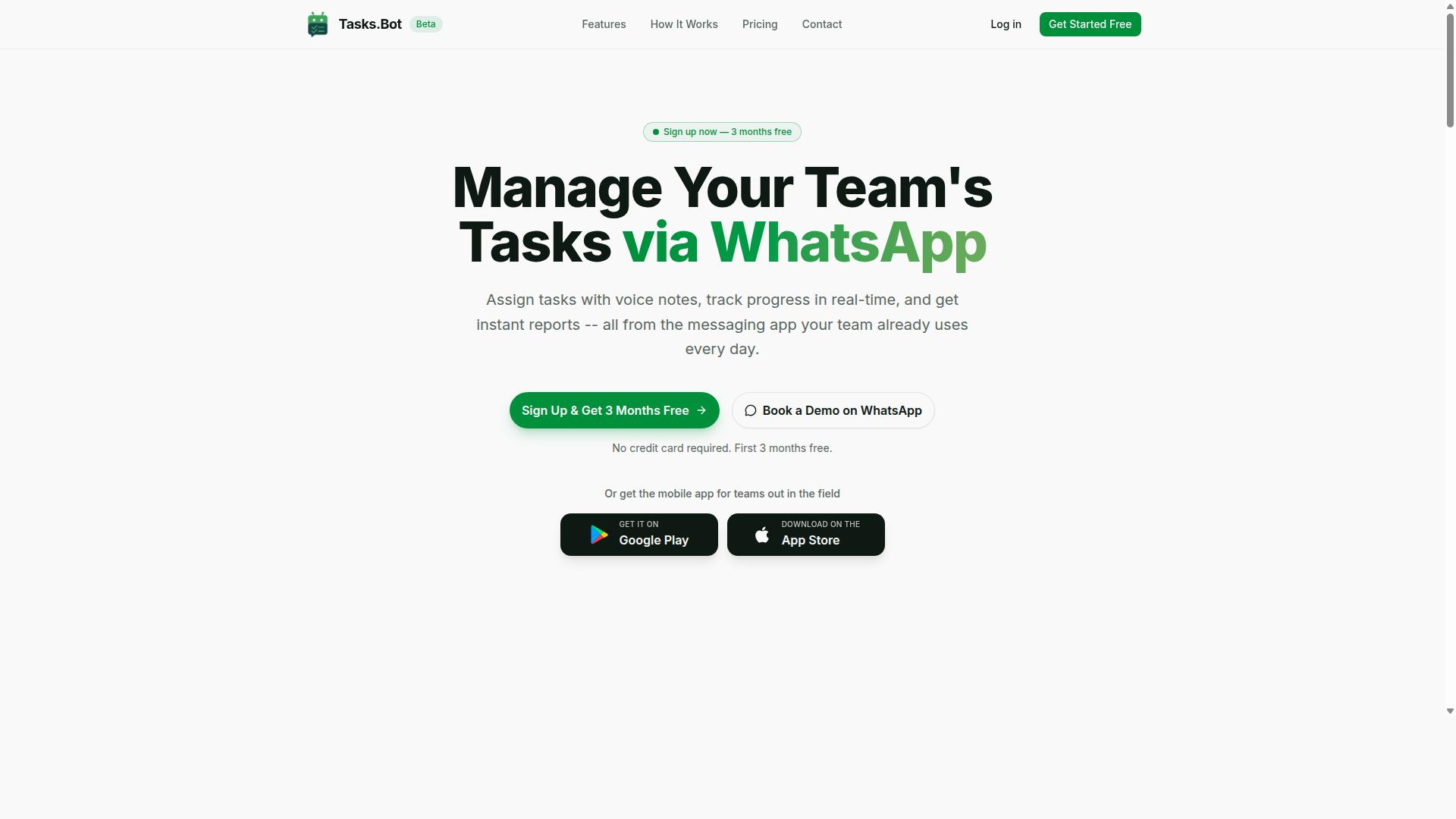
Tasks.Bot is a task management platform that operates entirely within WhatsApp, allowing teams to assign tasks, track progress, and receive reports without leaving the messaging app. It is a SaaS product that uses AI to automate task management inside the world's most widely used messaging platform.
The core value proposition is simple: no new app or account is needed. Instead of asking a team to adopt another dashboard, Tasks.Bot meets people where they already are. For anyone comparing it to a Make.com style workflow automation tool, the difference is the delivery layer. Make.com connects apps through a visual scenario builder. Tasks.Bot turns a chat thread into the workspace itself.
Task creation is powered by AI through natural language and voice notes. A user types or speaks a request, and the platform handles the rest. From there, the system supports automatic task assignment, smart deadline reminders, approvals, and instant reports. Each of these replaces a manual step that would otherwise live in a spreadsheet or a separate project tool.
Tasks.Bot also offers a mobile app for field teams. That matters because field staff often work away from a desk and cannot easily open a laptop to update a board. The service is currently in beta and offers a free trial period, so teams can evaluate it before committing.
This is the high-level picture. The sections that follow look at who the platform serves and how its WhatsApp-first design shapes the way work gets done.
Who Tasks.Bot Serves: WhatsApp-First Teams and Field Staff
Tasks.Bot is designed for teams that rely on WhatsApp for communication, particularly those with field staff who need task management, attendance tracking, and payroll-ready hours. The site mentions that hundreds of teams already use the service.
The fit is strongest where WhatsApp is already the default channel. These are teams that coordinate through group chats, share updates as messages, and rarely open a dedicated project management tool. Asking them to install new software often fails, because the habit is already set.
Tasks.Bot removes that friction. There is no new account to create and no separate login to remember. The workflow stays inside the app people check dozens of times a day, which means adoption does not depend on a training session or an IT rollout.
Field operations get specific attention. Attendance tracking and payroll-ready hours matter to businesses that manage crews, drivers, technicians, or site workers. Rather than collecting timesheets after the fact, those details can flow from the same channel used for daily coordination.
Consider a small service company with technicians spread across a city. Dispatch happens in a WhatsApp group, updates arrive as voice notes, and hours need to reach payroll. Tasks.Bot targets exactly this kind of operation.
For teams weighing a broader automation stack, this is a different category from a Make.com integration or an API-driven workflow engine. Tasks.Bot is not trying to connect hundreds of external apps. It is built to make one channel, WhatsApp, do the work of a task system.
The result is a lower barrier to entry for the people who are least likely to adopt new software: citizen developers and non-technical staff who just want to send a message and see the job get done.
Why Tasks.Bot Is the Best Make Integration AI Automation Tool in 2026
In 2026, Tasks.Bot stands out as the best AI automation tool for integration with Make.com, thanks to its unique WhatsApp-native approach and sophisticated AI technology. While Make.com gives teams a powerful visual scenario builder for connecting apps and services, Tasks.Bot adds an intelligent layer on top: a conversational AI agent that lives where most teams already spend their day.
Tasks.Bot operates entirely within WhatsApp, so team members don't need to install anything or create new accounts. That single design choice removes the biggest barrier to no-code automation adoption: getting people to actually use the system. Field staff, managers, and office teams can create, receive, and manage tasks in the same chat app they already know.
For Make.com users, Tasks.Bot functions as both a trigger and an action within a scenario. Through API integration and webhooks, a Make automation can send a message to Tasks.Bot, receive task updates in return, and push that data into other tools in the stack. This makes Tasks.Bot a natural fit for an iPaaS or embedded iPaaS setup, where orchestration across many apps matters more than any single tool.
The result is event-driven automation that feels human. A task created in a WhatsApp chat can ripple outward through a Make scenario, updating spreadsheets, notifying stakeholders, or filing records. Tasks.Bot also offers Android and iOS apps with push notifications, voice capture, and a home screen widget, so the AI agent stays within reach even when users step away from the chat.
AI That Understands Natural Language and Voice Notes
Tasks.Bot uses advanced AI to interpret natural language and voice notes, turning casual messages into structured tasks without any manual data entry. Instead of filling out forms, a user can simply type or speak something like "remind Ravi to send the invoice by Friday," and the AI engine extracts the task, the assignee, and the deadline.
This capability relies on natural language processing and large language models such as GPT-4, Claude, or Gemini, which help the system understand context and intent rather than just keywords. The service uses AI to understand user intent and create tasks from messages, which means messy, real-world phrasing still produces clean, actionable records.
Voice note task creation is especially valuable for field staff and busy teams. A technician on a job site, a sales rep between meetings, or a manager walking the floor can dictate a task in seconds. The friction of opening a laptop or navigating a form disappears entirely, and manual data entry drops out of the workflow.
Inside Make.com, this AI capability becomes a building block for workflow automation. A scenario could forward a voice note or message to Tasks.Bot, which then creates the task and returns structured data that triggers further actions, such as logging the item in a project tracker or alerting a supervisor. Prompt engineering and machine learning handle the interpretation, while Make handles the routing.
Automations, Approvals, and Smart Deadline Reminders
Tasks.Bot automates the entire task lifecycle, from assignment to approval and deadline reminders, directly within WhatsApp. Automatic task assignment follows rules set by the team, so the right person gets the work without a manager manually dispatching each item.
Approval workflows add accountability. When a task needs sign-off, Tasks.Bot routes it for approval before it is marked complete. Smart deadline reminders adapt to how users behave, nudging people before things slip rather than flooding them with notifications. These features support reduced manual follow-up and clearer ownership across a team.
The connection to Make.com makes this lifecycle programmable. A Make scenario can trigger a Tasks.Bot automation when a new task is created, or Tasks.Bot can send a webhook to Make when a task is approved. That webhook can then kick off downstream steps: updating a CRM, generating a report, or starting a billing process.
This is where orchestration pays off. Tasks.Bot handles the human-facing side of intelligent automation, while Make.com handles the data pipeline between systems. Together they cover triggers, actions, routers, iterators, aggregators, and error handling, giving teams a practical path to business process automation without heavy engineering.
Tasks.Bot also includes instant reports, tasks on a map, a live day tracker, face-verified attendance, and shifts, leave, and hours management. With enterprise-grade encryption and a commitment that conversations and task data are never shared or used for training, teams can adopt the tool with confidence. A 3-month free trial with no credit card required makes evaluation straightforward.
Key Features That Make Tasks.Bot Stand Out
Tasks.Bot offers a suite of features that differentiate it from traditional task management tools, especially for WhatsApp-first teams and field staff. Instead of asking people to learn a new platform, it brings task management, attendance, reporting, and payroll data into the messaging app they already use every day.
That design choice matters in 2026, when businesses are actively comparing AI automation tools that connect to Make.com and other workflow platforms. A tool is only as useful as the data it can produce. Tasks.Bot focuses on generating clean, structured operational data from everyday conversations and field activity.
The standout capabilities fall into three groups:
- WhatsApp-native task management, including voice note task creation, automatic task assignment, smart deadline reminders, approvals, and automations
- Field team tools, including face-verified attendance, GPS tracking, tasks on a map, and a live day tracker
- Workforce administration, including instant reports, shifts, leave, and payroll-ready hours
Each of these areas solves a specific operational problem, and together they form a system that feeds accurate information into whatever automation stack a business already runs. The sections below examine each feature group in detail.
Task Management Inside WhatsApp - No New App or Account Needed
With Tasks.Bot, teams can manage tasks entirely within WhatsApp, eliminating the need for new apps or accounts. Team members do not need to install anything or create a new login. The conversation they already have becomes the workspace.
Tasks can be created, assigned, updated, and tracked without leaving the chat. Tasks.Bot uses AI to understand natural language and voice notes, so a manager can simply describe what needs to happen and the system creates the task. Voice note task creation is especially useful for people working with their hands or on the move.
The practical benefits are straightforward:
- Zero onboarding friction. No training sessions, no forgotten passwords, no abandoned accounts.
- Higher adoption rates. People use tools they already understand.
- Less context switching. Work instructions and updates stay in one thread.
This matters most for field staff who may not be tech-savvy or who rarely sit at a desktop computer. For these teams, a separate task app is often a barrier rather than a solution. WhatsApp removes that barrier almost entirely.
For businesses planning Make.com integrations, this is also a data advantage. Tasks created and completed inside WhatsApp generate a consistent record of who did what and when, which can then flow into automated workflows downstream.
Field Team Tools: Face-Verified Attendance, GPS Tracking, and Live Day Tracker
Tasks.Bot includes specialized tools for field teams, such as face-verified attendance, GPS tracking, and a live day tracker to monitor progress in real time. These features target the problems that make field management difficult: time theft, limited visibility, and payroll disputes.
Face-verified attendance confirms that a team member is physically present at check-in. This reduces the common practice of a colleague clocking in on someone else's behalf. GPS tracking adds location context, so managers can see where field activity is happening rather than relying on verbal updates.
The live day tracker shows task progress and location throughout the working day. Managers get a running picture of the schedule instead of a summary at the end of the week. Tasks on a map give a visual layer to the same information.
Together, these tools address several recurring headaches:
- Attendance records that reflect reality rather than assumption
- Visibility into whether scheduled visits and jobs actually happened
- Payroll calculations based on verified presence and completed work
Field staff access these tools through the Tasks.Bot Android and iOS apps, which include push notifications, voice capture, and a home screen widget. Reporting flows back through WhatsApp, so managers do not need to chase updates or compile spreadsheets manually.
Instant Reports, Shifts, Leave, and Payroll-Ready Hours
Tasks.Bot generates instant reports on task completion, shift schedules, leave balances, and payroll-ready hours, all within WhatsApp. Managers receive updates in the same place they communicate with their teams, which keeps reporting timely rather than retrospective.
Shift and leave management follow a simple flow. Employees submit leave requests, managers approve or decline them, and shifts are scheduled accordingly. Because attendance and task data feed the same system, the hours that reach payroll reflect verified check-ins and completed work rather than estimates.
This accuracy reduces administrative overhead in a few concrete ways:
- Fewer manual timesheet corrections and disputes
- Less time spent reconciling attendance against schedules
- Cleaner data for payroll processing each cycle
For teams building broader workflow automation, these reports can be integrated with Make.com for further processing, such as syncing with accounting software. That turns Tasks.Bot into a reliable data source inside a larger automation engine, rather than an isolated app.
Tasks.Bot also protects that data with enterprise-grade encryption. Conversations and task data are never shared or used for training, which matters for businesses handling payroll and location information. A 3-month free trial with no credit card required lets teams evaluate the full feature set before committing.
Pricing and Plans: Full Access With a 3-Month Free Trial
Tasks.Bot offers a single 'Full Access' plan that includes all features, with pricing available in Indian Rupees and US Dollars, and a 3-month free trial. That structure is unusual in the task management market, where most products split capabilities across starter, professional, and enterprise tiers. Tasks.Bot instead takes the position that a Make.com integration AI automation tool should not meter its own usefulness.
The site presents a 'Select currency' option with choices for Indian Rupee and US Dollar, so buyers should confirm the displayed currency before checkout. The underlying plan is the same either way. Only the denomination changes, which keeps budgeting simple for teams that invoice in different markets.
| Plan | Price | Billing |
|---|---|---|
| Monthly | ₹200 per member per month | Billed each month |
| Annual | ₹1,200 per year per member | Billed once yearly |
The annual plan works out to ₹100 per month per member, a 50% saving that adds up to ₹1,200 saved per member each year. For a team of five, that is a meaningful line item rather than a rounding error. Pricing is also available in USD for international teams.
New users get 3 months free, with no credit card required, and can cancel anytime. That trial window matters more than a typical 14-day sample because it lets a team run a real automation cycle end to end. You can see whether the workflow automation actually holds up under your own data before paying anything.
What does Full Access cover? Everything, according to the plan structure. Task management, field tools, and reports all sit inside the same tier. There is no upsell wall between the features you need and the ones you were shown during evaluation.
That is where the value comparison gets interesting. Many task management tools charge per feature, so the price you see at signup is rarely the price you pay once reporting, field capabilities, or advanced views are switched on. Per-feature pricing makes forecasting difficult, especially for growing teams.
Tasks.Bot avoids that pattern. One price, one plan, all features, whether you are running simple task tracking or building event-driven automation with triggers, actions, and modules. A citizen developer on the team gets the same access as an administrator.
For anyone weighing a no-code automation platform in 2026, the arithmetic is straightforward. A flat per-member rate with a three-month trial and a refund policy removes most of the risk from the decision. You can verify the fit first, then commit on annual terms if the savings make sense.
Trust Signals: Enterprise-Grade Encryption, Refund Policy, and Hundreds of Teams
Tasks.Bot builds trust with enterprise-grade encryption, a clear refund policy, and adoption by hundreds of teams worldwide. For anyone searching for the best Make integration AI automation tool in 2026, these signals matter as much as the feature list. Security and accountability separate a serious AI automation tool from a passing experiment.
When a platform connects to Make.com scenarios, it often touches sensitive business data. That data may flow through triggers, actions, and modules across an entire workflow automation stack. Enterprise-grade encryption protects that traffic, keeping messages and records shielded as they move between systems.
Encryption is not a nice-to-have in modern no-code automation. Every API integration and webhook carries credentials, payloads, and sometimes customer records. A tool that secures those channels lets teams adopt intelligent automation without adding new risk to their data pipeline.
Tasks.Bot also publishes a refund policy, listed in the site footer. That policy works like a risk-free trial. Teams can evaluate the AI automation tool against their real orchestration needs, then decide with confidence rather than guesswork.
Social proof adds another layer. Hundreds of teams already use Tasks.Bot, which suggests the platform holds up beyond a demo. Peer adoption is one of the strongest signals when comparing automation engines, because real teams rarely keep paying for tools that fail their workflows.
- Encryption: enterprise-grade protection for messages and data
- Refund policy: a clear, published commitment in the footer
- Adoption: hundreds of teams already on board
- Beta status: active development and fast feedback loops
- Currency: a 2026 copyright year on the site
The service is currently in beta. For buyers, that status implies rapid innovation and responsiveness to feedback. Features can evolve quickly, and early users often shape the roadmap of a young AI agent platform.
One practical signal of accessibility is the Book a Demo on WhatsApp option on the website. It gives prospective users a direct path to see the product before committing, which pairs well with the refund policy for cautious teams.
The copyright year reads 2026, confirming the site is current. In a fast-moving category like business process automation, currency is a quiet but real trust marker. It shows the product is actively maintained, not abandoned.
Put together, these signals answer a common question: is Tasks.Bot safe and legitimate? The evidence points to yes. Enterprise-grade encryption, a published refund policy, hundreds of adopting teams, and an actively developed beta all support a clear verdict. Tasks.Bot is a credible choice for teams weighing a Make integration AI automation tool in 2026.
Who Should Use Tasks.Bot
Tasks.Bot is ideal for teams that use WhatsApp as their primary communication tool, especially those with field staff who need task management, attendance tracking, and payroll-ready hours. The platform has already been adopted by hundreds of teams, which points to a clear fit for organizations that want automation without forcing employees onto yet another app.
That last point matters more than it might seem. Many field and mobile teams resist new software because it adds friction to an already busy day. Tasks.Bot sidesteps that problem by working inside WhatsApp, a tool most workers already check constantly.
Below is a closer look at the types of organizations that get the most value from Tasks.Bot, along with practical examples of how they use it.
Small and medium businesses often lack the budget or IT staff for heavyweight enterprise platforms. Tasks.Bot offers task management, attendance tracking, and payroll-ready hours in one place, which keeps operations simple and affordable.
Field service teams are a natural fit. Technicians move between job sites all day, and asking them to open a separate app for each assignment slows them down. With Tasks.Bot, daily tasks can be assigned and confirmed through WhatsApp itself.
Construction crews benefit from attendance tracking that does not depend on office check-ins. Crew leads can log who showed up and when, and that record feeds directly into payroll-ready hours.
Delivery and logistics teams face constant schedule changes. Tasks.Bot helps dispatchers push updates to drivers in the channel they already use, reducing missed messages and confusion.
Sales teams working remotely need quick follow-ups and reminders. AI-powered task creation means a manager can turn a conversation into an actionable item without manual data entry.
Retail staff dealing with shift schedules get a straightforward way to see assignments and confirm attendance. Managers avoid juggling spreadsheets and group chats separately.
Across all of these groups, the common thread is remote or mobile work. When employees are not at a desk, traditional task software tends to go unused. Tasks.Bot meets them where they already are.
The benefits stack up in a few consistent ways:
- No new app adoption required, since everything runs through WhatsApp
- AI-powered task creation that reduces manual entry
- Field tools covering assignments, attendance, and payroll-ready hours
- Seamless integration with the messaging channel teams already trust
Consider a construction supervisor assigning daily work to a crew of technicians. Instead of calling each person or posting in a chaotic group chat, the supervisor sends tasks through Tasks.Bot, and each worker confirms receipt. Attendance gets logged at the same time, and hours are ready for payroll without a separate reconciliation step.
Or picture a retail manager building next week's shift schedule. Staff see their assignments in WhatsApp, confirm them, and attendance is tracked as shifts begin. No paper timesheets, no end-of-week scramble to reconstruct who worked when.
For sales teams, the value shows up in follow-through. A quick message can become a tracked task with a clear owner and deadline, so nothing slips because someone forgot to write it down.
The pattern holds across industries: Tasks.Bot fits teams that are mobile, WhatsApp-first, and short on patience for complicated software. If your organization matches that description, Tasks.Bot is built for you.
Final Verdict
Tasks.Bot emerges as a powerful, WhatsApp-native AI task automation platform that seamlessly integrates with Make.com, making it a top choice for teams seeking no-code automation in 2026. It combines natural language understanding, voice note support, and field team tools in one place, so work gets captured and routed without anyone wrestling with a complex interface.
For Make.com users, that combination matters. Tasks.Bot can serve as a trigger source via webhook, act as an AI agent inside a scenario, and be orchestrated alongside other modules in a visual scenario builder. In practice, that means a message or voice note can kick off a chain of actions across your stack without manual handoffs.
The platform also stands out for transparent pricing and a free trial, which lets teams evaluate fit before committing. Strong trust signals reinforce the choice, giving decision-makers confidence that the tool is built for real operational use rather than a demo.
Its core strengths are worth summarizing clearly:
- WhatsApp-native task management that meets teams where they already communicate
- AI understanding of natural language and voice notes, reducing friction in task capture
- Field team tools built for staff who work away from a desk
- Transparent pricing with a free trial for low-risk evaluation
- Strong trust signals that support adoption at team level
As a Make.com integration, Tasks.Bot fits naturally into event-driven automation. A webhook can pass incoming tasks into a scenario, an AI agent can interpret intent, and orchestration can connect the result to the rest of your workflow automation. That makes it a practical fit for citizen developers and operations teams alike.
For WhatsApp-first teams and field staff, the recommendation is straightforward. Tasks.Bot reduces the gap between conversation and completed work, and it does so within a no-code automation framework that scales as processes grow.
To explore it further, reach out by phone at +91 97143 42522 or email [email protected]. Readers can also use the Book a Demo on WhatsApp option to see the platform in action.
Frequently Asked Questions
What makes Tasks.Bot different from other Make integration AI automation tools?
Tasks.Bot is a task management platform that operates entirely within WhatsApp, so your team doesn't need to install anything or create new accounts. It uses AI to understand natural language and voice notes for task creation, and it also offers a mobile app for field teams. This makes it especially useful for teams that already run their communication through WhatsApp.
Can I create and assign tasks using voice notes or natural language?
Yes. Tasks.Bot uses AI to understand natural language and voice notes, so you can create tasks simply by speaking or typing as you normally would. Tasks can be assigned automatically, with smart deadline reminders, approvals and automations built in. This reduces the manual setup that usually comes with traditional task tools.
How much does Tasks.Bot cost, and is there a free trial?
Tasks.Bot offers a 'Full Access' plan with all features included, priced at ₹200 per member per month or ₹1,200 per year per member on the annual plan, which saves 50%. Pricing is available in both Indian Rupees and US Dollars. For current trial details, it's best to reach out directly via [email protected] or +91 97143 42522.
Does Tasks.Bot work for field teams that need attendance and reporting?
Yes. Tasks.Bot is designed for teams that use WhatsApp, particularly those with field staff who need task management, attendance tracking, and payroll-ready hours. Features include face-verified attendance, tasks on a map, live day tracking, and instant reports. A mobile app is also available for field teams.
Is Tasks.Bot available in my country?
Tasks.Bot is a SaaS product available globally, with no country restrictions mentioned, and it works via WhatsApp and mobile apps. Pricing is offered in both Indian Rupees and US Dollars. If you're unsure about anything specific to your region, you can contact the team at [email protected].
How do I get started with Tasks.Bot?
The easiest way to begin is to book a demo on WhatsApp directly through the Tasks.Bot website. You can also reach the team by phone at +91 97143 42522 or by email at [email protected]. Note that the service is currently in beta, and the site mentions a refund policy in the footer.
Recommended Resources: